
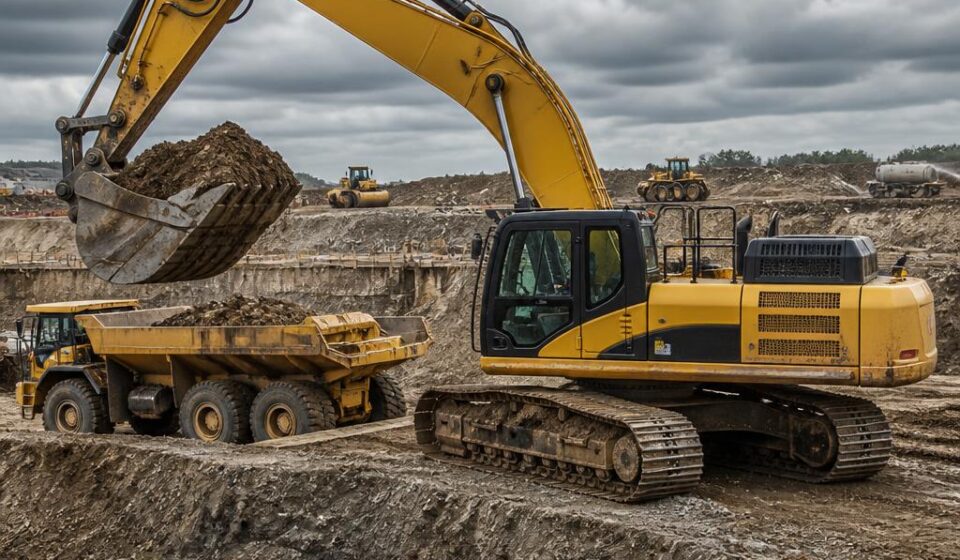

Excavator tracks churn earth on countless job sites, but you’re here for the real workhorse: the crawler excavator. You’ll discover what makes these machines so uniquely powerful and why their continuous tracks offer unparalleled stability on challenging terrain. But be warned, their sheer size also presents significant operational challenges if you’re not properly prepared.
Table of Contents
What’s the deal with all these different crawler types?
You’ve probably noticed that not all crawler excavators look the same, right? There’s a whole family of them, each designed for specific tasks and environments. Understanding the nuances between a standard excavator and a mini excavator, for instance, can seriously impact your project’s efficiency and budget.
- Standard Excavators: These are your everyday workhorses for big jobs.
- Mini Excavators: Perfect for tight spots and smaller projects.
- Long Reach Excavators: Great for dredging or demolition from a distance.
- Spider Excavators: Unbelievably versatile on uneven terrain.
- Zero Tail Swing Excavators: Ideal for urban sites where space is premium.
Recognizing the right tool for the job is half the battle won.
The standard heavy hitters you’ll see on every big site
These are the Goliaths of the construction world, built for serious digging and heavy lifting. You’ll spot large crawler excavators moving mountains of earth, demolishing structures, and handling massive pipelines. They’re incredibly powerful but need ample space to operate safely and efficiently.
Compact rigs that are honestly a lifesaver in small spaces
When you’re squeezed for room, these little machines are your best friends. Mini excavators and compact excavators are designed for agility, fitting into backyards, indoor demolition, or roadside work without blocking traffic. They might be small, but they pack a surprising punch for their size.
These smaller excavators are particularly adept in residential landscaping, utility trenching, or any project where larger equipment would be impractical or cause too much disruption. Their reduced weight also means less ground disturbance, which can be a huge advantage on sensitive sites where you don’t want to damage existing infrastructure or lawns. Plus, they’re often easier to transport between job sites, saving you time and money on logistics.
How do you actually pick the right one? Here’s what matters
Picking the right crawler excavator isn’t just about grabbing the biggest one you can find – that’s a common, expensive mistake. You’ve really got to match the machine’s capabilities to your specific job site needs, or you’re looking at wasted fuel and inefficient work. It’s all about finding that sweet spot.
Figuring out how much engine power you’re really gonna use
Your engine power needs depend on what you’re digging and how fast. Think about the material’s density and if you’re working on slopes. Too little power means slow progress; too much is just burning money for no reason.
Why digging depth is a huge factor you just can’t ignore
Digging depth is probably the most critical specification when you’re looking at excavators. If your machine can’t reach the required depth, well, you simply can’t do the job. You’ll need to know the maximum excavation depth your project requires, then compare that directly to the excavator’s published specifications. Don’t forget to account for any attachments that might reduce reach slightly, and always give yourself a little buffer – you don’t want to be at the absolute limit all day, as that stresses the machine and slows things down.
Pros and cons: My honest take on using a crawler
You’re probably wondering, “Are crawler excavators *really* all they’re cracked up to be?” Well, let’s get down to brass tacks. I’ve spent countless hours in these machines, and I’ve got a pretty clear picture of where they shine and where they can be a bit of a headache.
| Pros | Cons |
|---|---|
| Unmatched stability on uneven ground. | Slow travel speed from site to site. |
| Superior traction in mud, sand, and loose soil. | Requires specialized transport (lowboy trailer). |
| Excellent digging force and lifting capacity. | Tracks can cause damage to finished surfaces. |
| Precise control for delicate operations. | Higher maintenance on tracks and undercarriage. |
| Can work on slopes where wheeled machines can’t. | More expensive to purchase and operate initially. |
| Distributes weight evenly, reducing ground pressure. | Limited maneuverability in tight spaces. |
Why I think the stability is a total game-changer
That wide track base isn’t just for show; it’s what gives a crawler its incredible stability. You can reach further, lift heavier, and dig deeper without feeling like you’re going to tip over. This translates directly to safer and more efficient work, especially on challenging sites.
The tricky parts about moving these big machines around
Moving a crawler excavator from one job site to another is not like driving your pickup truck. These machines are big, they’re heavy, and they’re slow. You’re definitely going to need a specialized lowboy trailer and a permit for anything but the shortest hops. And this isn’t just about the trailer itself; you’ve got to consider the logistics of loading and unloading, securing the machine properly, and navigating traffic with an oversized load. It adds a whole layer of planning and cost to your project, which is something you absolutely need to factor into your budget.
My step-by-step guide to operating like a pro
You’ve done your homework, picked your machine, and now it’s time to get down to business. Operating a crawler excavator effectively isn’t just about moving dirt; it’s about precision, safety, and efficiency. Think of it as a dance between you and the machine, where every movement counts.
Getting the pre-start inspection done the right way
Before you even think about firing up that engine, a thorough pre-start inspection is non-negotiable. You’re looking for anything amiss – loose hoses, hydraulic leaks, or worn tracks. Never skip this step; it’s your first line of defense against accidents and costly breakdowns.
How to master the controls without breaking a sweat
Understanding the controls is where the real magic happens. Each lever and pedal has a purpose, and getting comfortable with them takes practice. Start slow, focus on smooth, deliberate movements, and you’ll soon be operating with confidence.
Your left joystick typically controls the swing and the dipper arm, while the right handles the boom and bucket. The two foot pedals, or sometimes a single lever, will move your tracks forward and backward. It’s a bit like patting your head and rubbing your stomach at first, but with a bit of repetition, you’ll develop the muscle memory needed for fluid, coordinated movements. Always keep your eye on the bucket and its surroundings.
| Step | Action |
|---|---|
| 1. Pre-Operation Check | Walk around the machine. Check fluid levels, inspect tracks for damage, and ensure all safety guards are in place. Look for any leaks or loose connections. |
| 2. Enter the Cab Safely | Always use three points of contact when entering or exiting the cab. Adjust your seat and mirrors for optimal visibility. |
| 3. Start the Engine | Follow the manufacturer’s specific starting procedure. Allow the engine to warm up for a few minutes before putting it under load. |
| 4. Get Familiar with Controls | Practice moving the boom, stick, and bucket in an open, safe area. Get a feel for the joystick responsiveness and track controls. |
| 5. Digging Technique | Approach digging systematically. Start by creating a trench, then gradually deepen and widen it, always being mindful of stability and ground conditions. |
| 6. Swinging and Dumping | Swing smoothly and avoid sudden stops. Dump the material evenly and return the bucket to the digging position with controlled movements. |
| 7. Shut Down Procedure | Park on level ground, lower all attachments, and follow the manufacturer’s shutdown sequence. Engage the parking brake. |
A few quick tips to keep things running smoothly
Keeping your crawler excavator in top shape isn’t rocket science, but it does require a little consistent effort. You’ll want to make sure you’re always on top of the basics. After every shift, give it a quick once-over.
- Always check your fluid levels – engine oil, hydraulic fluid, coolant.
- Grease those pivot points regularly; it prevents a lot of wear and tear.
- Keep an eye on the tracks for any damage or excessive tension.
- Clean out the radiator and engine bay to prevent overheating.
Simple maintenance tricks that’ll save you a headache
You can avoid bigger problems down the line with some simple habits. For instance, always let the engine warm up properly before starting any heavy work – it’s good for the hydraulics and the engine itself. And don’t forget to clean the air filter regularly, especially in dusty conditions; it really impacts performance.
What I do to stay safe when the terrain gets sketchy
Operating on uneven ground demands your full attention and a bit of foresight. Always assess the slope and stability before you even think about moving. And never, ever swing a heavy load uphill; it’s just asking for trouble.
You’ve got to trust your gut when the ground feels iffy. If it looks too soft or too steep, it probably is. I always try to keep the boom low and the bucket close to the machine when traversing slopes, which helps lower the center of gravity and makes the excavator much more stable. And always wear your seatbelt, no matter how short the move – it’s your last line of defense against a nasty spill.
Summing up
You’ve now got a solid grasp of crawler excavators, from their diverse types to the critical factors in choosing one. Understanding their operation and maintenance will ensure you’re well-equipped for any job site challenge, making your projects more efficient and safer.
FAQ
Q: How do crawler excavators handle different types of terrain compared to wheeled excavators?
A: Crawler excavators, with their track-based propulsion system, distribute their weight over a much larger surface area. This significantly reduces ground pressure, allowing them to operate effectively on soft, uneven, or muddy terrain where wheeled excavators would quickly get stuck. Think about a construction site after heavy rain – you’ll almost always see crawlers still making progress.
Wheeled excavators, on the other hand, are built for speed and mobility on harder, more stable surfaces. They’re excellent for road construction, urban projects with paved areas, or sites where they need to move between tasks quickly without the need for a separate transport vehicle. But try to put one in deep mud, and you’re going to have a bad time.
Q: What are the primary factors influencing the fuel efficiency of a crawler excavator?
A: Fuel efficiency in a crawler excavator is a pretty complex equation, but a few key factors really stand out. Engine size and technology are huge – newer models often incorporate advanced common rail fuel injection systems and turbochargers that optimize combustion, giving you more power for less fuel.
Operator technique plays a surprisingly large role too. Smooth, controlled movements, avoiding sudden accelerations, and not over-revving the engine when it’s not under load can make a significant difference over a long shift. And, of course, the actual task at hand matters; digging dense, compacted earth requires more power – and thus more fuel – than simply moving loose topsoil.
Regular maintenance, like keeping air filters clean and hydraulic systems properly serviced, also ensures the engine isn’t working harder than it needs to, which in turn saves on fuel consumption.
Q: Can crawler excavators be adapted with different attachments for varied tasks, and what are some common examples?
A: Absolutely, that’s one of their biggest strengths! Crawler excavators are incredibly versatile machines precisely because they can swap out attachments. This adaptability allows a single excavator to perform a wide range of jobs, boosting productivity on a site.
You’ll commonly see them fitted with hydraulic hammers, perfect for breaking up concrete or rock. There are also various types of buckets – trenching buckets for narrow excavations, grading buckets for finishing work, and heavy-duty rock buckets for tougher materials. Grapples are another popular attachment, used for handling demolition debris, logs, or scrap metal.
Shears are fantastic for cutting through steel in demolition, and augers can be attached for drilling holes for foundations or utility poles. The quick coupler system on most modern excavators makes these changeovers relatively fast, minimizing downtime and maximizing the machine’s utility.


